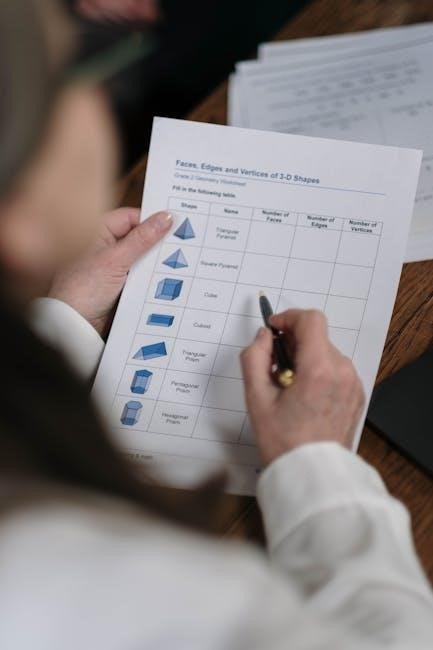
Article Plan: Year 5 Maths Worksheets with Answers PDF
Discover comprehensive Year 5 maths resources, including downloadable PDF worksheets with solutions, covering core topics like fractions, decimals, and problem-solving – ideal for classroom or home learning!
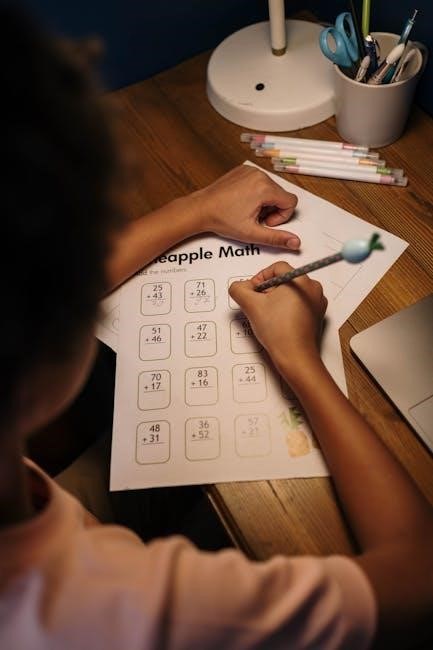
Year 5 marks a pivotal stage in a child’s mathematical journey, building upon foundational concepts and introducing more complex ideas. These maths worksheets, available as convenient PDF downloads with included answers, are specifically designed to support students navigating this crucial year. They offer targeted practice across a broad spectrum of topics, ensuring a solid grasp of essential skills.
These resources aren’t just about rote learning; they’re crafted to foster a deeper understanding of mathematical principles. From mastering multi-digit arithmetic to tackling fractions and decimals, the worksheets provide ample opportunity for students to hone their abilities. The inclusion of answer keys allows for self-assessment and independent learning, empowering students to take ownership of their progress. Furthermore, resources like those from Ninja Maths offer focused practice on specific areas, like fractions, while assessments provide a comprehensive overview of a student’s understanding.
Whether used in the classroom, for homework, or as supplementary learning materials, these Year 5 maths worksheets are an invaluable tool for both educators and parents.
Core Maths Topics for Year 5
Year 5 maths worksheets with answers comprehensively cover essential topics, building a strong mathematical foundation. Key areas include Number and Place Value, focusing on understanding larger numbers and their representation. Addition and Subtraction skills are reinforced with multi-digit problems, often involving multi-step calculations, as seen in practice booklets covering Units 3-6.
Multiplication and Division are also central, with worksheets designed to improve fluency and problem-solving abilities. A significant portion of the curriculum is dedicated to Fractions, encompassing equivalent fractions, addition, subtraction, and finding fractions of amounts – resources readily available online.
Furthermore, students explore Decimals and Percentages, learning to understand decimal place value and convert between these representations. Assessments, like the 40-question tests, evaluate proficiency across these core areas. These PDF resources ensure students are well-prepared for future mathematical challenges, solidifying their understanding through targeted practice and readily available solutions.
Number and Place Value
Year 5 maths worksheets focusing on Number and Place Value are crucial for developing a solid understanding of the number system. These PDF resources help students confidently work with larger numbers, extending beyond thousands into ten thousands, hundred thousands, and beyond. Worksheets emphasize recognizing the value of each digit and understanding its place within a number.
Exercises include identifying place value, ordering numbers, comparing their sizes, and rounding to the nearest 10, 100, or 1000. Students practice reading and writing numbers in both numerals and words. These skills are foundational for all other mathematical operations.
Many worksheets incorporate problem-solving scenarios, requiring students to apply their understanding of place value in real-world contexts. The inclusion of answers allows for self-assessment and reinforces correct understanding, building confidence and mastery of these essential concepts. Assessments often include these topics, ensuring proficiency.
Addition and Subtraction (Multi-Digit Numbers)
Year 5 maths worksheets dedicated to Addition and Subtraction of multi-digit numbers build upon prior learning, focusing on fluency and accuracy with larger calculations. These PDF resources provide extensive practice with numbers extending into the thousands and ten-thousands, often involving multi-step problems.
Worksheets cover various methods, including column addition and subtraction, with and without regrouping (borrowing and carrying). Emphasis is placed on understanding the process and checking answers for reasonableness. Students encounter word problems requiring them to identify whether to add or subtract.

The inclusion of answers allows students to independently verify their work and identify areas needing improvement. Many worksheets present problems in a variety of formats, enhancing problem-solving skills. These exercises are vital for developing mental math strategies and preparing for more complex calculations later on, often appearing in assessments.
Multiplication and Division
Year 5 maths worksheets focusing on Multiplication and Division solidify understanding of these core operations, moving beyond basic times tables. PDF resources offer practice with multiplying and dividing multi-digit numbers by single-digit numbers, and increasingly, by two-digit numbers.
Worksheets incorporate various strategies, including the grid method, formal written methods, and utilizing known times tables facts. Division practice includes both short division (without remainders) and long division (with remainders), emphasizing interpreting what remainders mean in context.

Problem-solving is a key component, with word problems requiring students to determine whether multiplication or division is the appropriate operation. The provided answers facilitate self-assessment and error analysis. These exercises build a strong foundation for more advanced mathematical concepts, preparing students for tackling complex calculations and real-world applications.
Fractions Worksheets for Year 5
Year 5 maths worksheets dedicated to fractions build upon foundational understanding, progressing to more complex concepts. PDF resources provide extensive practice in identifying and working with fractions, including finding equivalent fractions – a crucial skill for later operations.
Worksheets cover adding and subtracting fractions with both common and uncommon denominators, requiring students to find common multiples. They also focus on fractions of amounts, challenging students to calculate fractions of whole numbers and quantities.
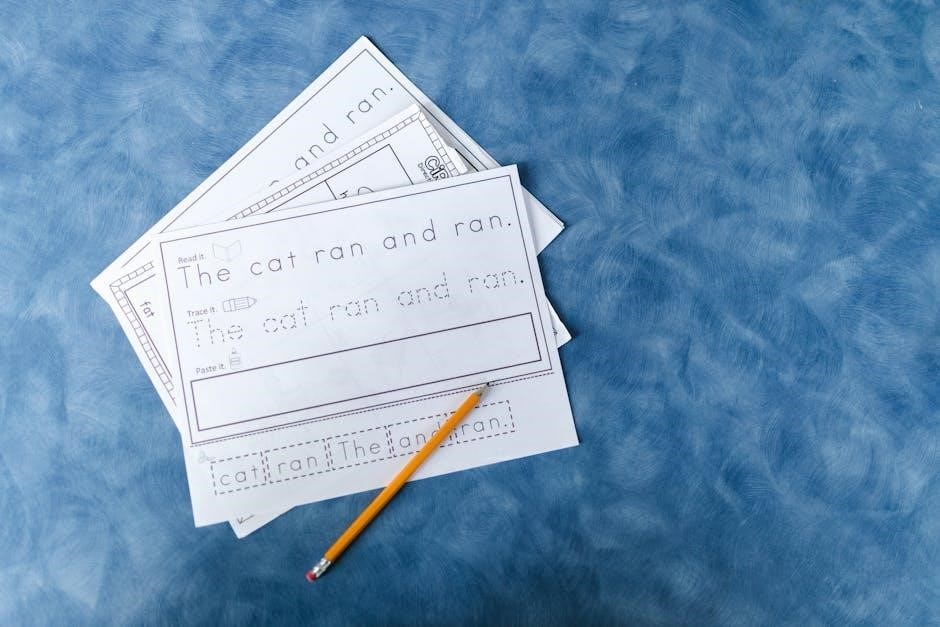
Visual models, like fraction bars and circles, are often incorporated to aid comprehension. Problem-solving scenarios are included, demanding application of fraction knowledge to real-world contexts. Complete answers are provided for immediate feedback and self-correction, reinforcing learning and identifying areas needing further practice. These resources ensure a solid grasp of fractional concepts.
Equivalent Fractions
Year 5 equivalent fractions worksheets in PDF format are designed to solidify understanding of this fundamental concept. Students practice identifying fractions that represent the same value, despite having different numerators and denominators. These worksheets often begin with visual representations, like shaded shapes, to demonstrate equivalence.
Progressing beyond visuals, students learn to generate equivalent fractions by multiplying or dividing both the numerator and denominator by the same number. Worksheets include exercises where students must find the missing numerator or denominator to create equivalent fractions.
More advanced exercises involve simplifying fractions to their lowest terms. Comprehensive answer keys are included, allowing for self-assessment and immediate feedback. Mastery of equivalent fractions is crucial for success with addition, subtraction, and comparison of fractions, making these worksheets an essential resource.
Adding and Subtracting Fractions
Year 5 adding and subtracting fractions worksheets, available as PDF downloads, build upon the foundation of equivalent fractions. Initially, these worksheets focus on fractions with common denominators, allowing students to practice adding and subtracting numerators while keeping the denominator constant. Visual models are frequently used to reinforce this concept.
As students progress, worksheets introduce fractions with different denominators. These require students to first find a common denominator – often the least common multiple – before performing the addition or subtraction. Step-by-step examples and guided practice are common features.
Worksheets also include mixed number problems, requiring conversion to improper fractions before calculation, and back to mixed numbers for the final answer. Detailed answer keys are provided, enabling independent learning and accurate self-checking. These resources are vital for developing fluency in fraction operations.
Fractions of Amounts

Year 5 fractions of amounts worksheets, readily available in PDF format, challenge students to apply their understanding of fractions to real-world scenarios. These worksheets typically present problems where students must calculate a fractional part of a whole number – for example, finding one-third of 27 or two-fifths of 60.
Initial worksheets often feature visual aids, such as diagrams divided into equal parts, to help students visualize the process. As students gain confidence, the worksheets progress to more abstract problems, requiring them to divide and multiply to find the answer.
Many resources include word problems, encouraging students to identify the relevant information and apply their fraction skills to solve practical challenges. Comprehensive answer keys are included, allowing for self-assessment and reinforcing correct methods. Mastering this skill is crucial for later mathematical concepts.
Decimals and Percentages Worksheets
Year 5 decimals and percentages worksheets, often found as downloadable PDFs, build upon the foundational understanding of fractions. These resources introduce students to decimal place value, starting with tenths and hundredths, and demonstrate how decimals relate to fractions – for instance, 0.5 representing one-half.
Worksheets progressively introduce converting between fractions, decimals, and percentages, emphasizing the equivalence between these representations. Students practice expressing fractions as decimals (e.g., 1/4 = 0.25) and decimals as percentages (e.g., 0.75 = 75%).
Many PDFs include practical exercises, such as calculating percentages of amounts (finding 20% of 80) and applying these skills to real-life scenarios like discounts and savings. Detailed answer keys are provided for immediate feedback and self-correction, solidifying understanding of these interconnected concepts.
Understanding Decimal Place Value
Year 5 maths worksheets focusing on decimal place value, typically available as PDF downloads, systematically introduce tenths, hundredths, and occasionally thousandths. These resources visually represent decimals using place value charts, helping students understand that each digit’s position dictates its value.

Worksheets often involve identifying the value of digits within a decimal number (e.g., in 3.45, the ‘4’ represents 4 tenths). Students practice writing decimals from given representations – like shaded grids or number lines – and vice versa.
Comparing and ordering decimals is a key skill reinforced through these PDFs, alongside exercises that require rounding decimals to the nearest whole number or tenth. Comprehensive answer keys allow for self-assessment, ensuring a firm grasp of this fundamental concept before progressing to more complex decimal operations.
Converting Between Fractions, Decimals and Percentages
Year 5 maths worksheets in PDF format dedicate significant practice to interconverting fractions, decimals, and percentages – a crucial skill for building numerical fluency. These resources typically begin with simple conversions, like changing halves, quarters, and fifths into their decimal and percentage equivalents.
Worksheets guide students through the process of dividing the numerator by the denominator to obtain the decimal form of a fraction. Conversely, they learn to express decimals as fractions (e.g., 0.75 = ¾) and percentages (75%).
Exercises often involve finding equivalent forms – expressing a fraction as a percentage or a decimal as a fraction. Answer keys are provided for immediate feedback, allowing students to solidify their understanding of these interconnected concepts and build confidence in applying them to various mathematical problems.
Measurement Worksheets
Year 5 maths worksheets, available as PDF downloads, extensively cover measurement skills, reinforcing practical application of mathematical concepts. These resources focus on standard units for length (millimetres, centimetres, metres, kilometres), mass (grams, kilograms), and capacity (millilitres, litres). Students practice converting between units within each measurement type.
A key area involves calculating perimeter and area of rectangles and squares, often presented with visual diagrams. Time-related problems are also prominent, including reading time on analogue and digital clocks, converting between 12-hour and 24-hour formats, and calculating duration.
Worksheets frequently include real-world scenarios, requiring students to apply measurement skills to solve practical problems. Comprehensive answer keys are included, enabling self-assessment and targeted practice to master these essential skills.
Length, Mass and Capacity
Year 5 maths worksheets focusing on length, mass, and capacity, provided in convenient PDF format, build a strong foundation in measurement. Students practice using metric units – millimetres, centimetres, metres, and kilometres for length; grams and kilograms for mass; and millilitres and litres for capacity.
These worksheets emphasize converting between different units within each measurement category (e.g., cm to m, g to kg); Practical exercises involve measuring objects in the classroom or at home, applying these skills to real-world contexts.

Problems often require comparing measurements, ordering them from smallest to largest, and solving simple word problems. Detailed answer keys are included, allowing students to check their work and identify areas needing further practice. Mastering these concepts is crucial for future mathematical development.
Time and Area
Year 5 maths worksheets dedicated to time and area, available as downloadable PDFs, reinforce essential skills. Time-related exercises cover reading and interpreting timetables, converting between analogue and digital clocks, and calculating durations of events. Students will practice using am and pm notation and understanding the number of seconds in a minute, minutes in an hour, and hours in a day.
Area worksheets focus on calculating the area of rectangles and squares using the formula length x width. Problems progressively increase in complexity, including irregular shapes that can be divided into simpler components.
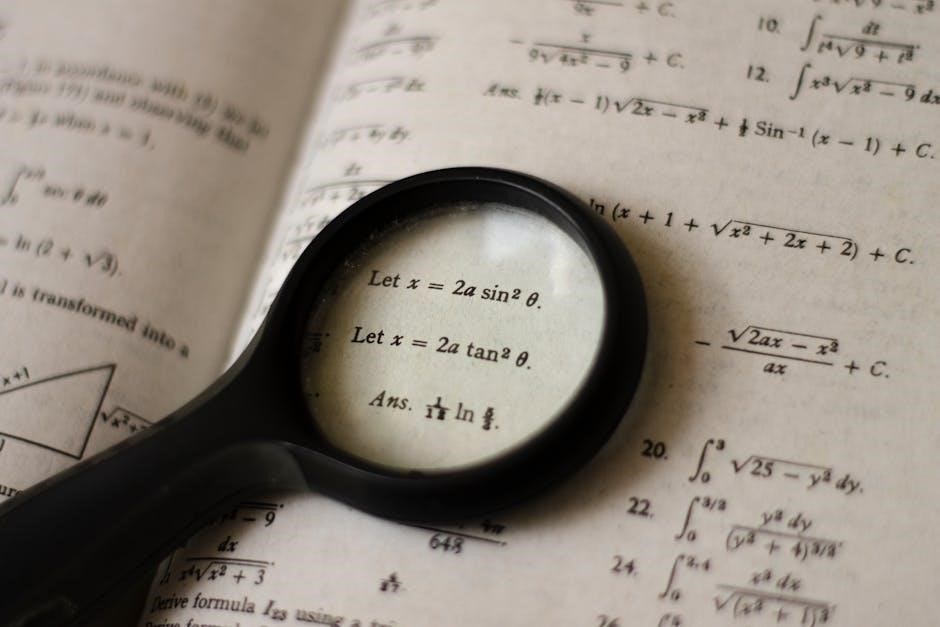
These resources often include practical applications, such as calculating the area of a room or the time taken for a journey. Comprehensive answer keys are provided, enabling self-assessment and targeted practice;
Solving Word Problems (Year 5 Level)
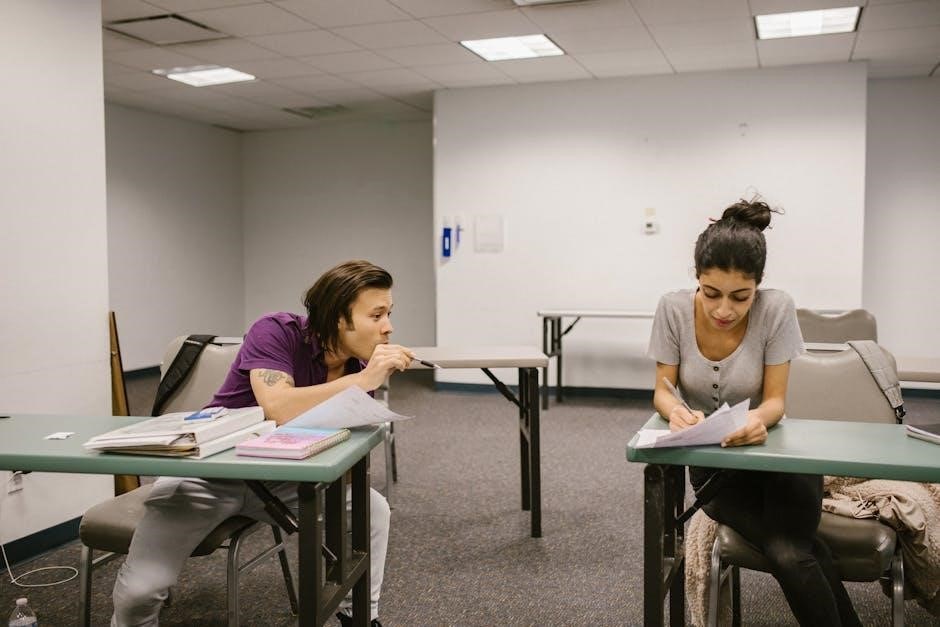
Year 5 maths worksheets focusing on word problems, provided in convenient PDF format, are crucial for developing problem-solving skills. These worksheets present mathematical concepts within real-world scenarios, requiring students to identify relevant information and choose appropriate operations – addition, subtraction, multiplication, or division.
Problems cover a range of topics, including money, measurement, time, and fractions. They often involve multi-step calculations, encouraging students to break down complex problems into smaller, manageable parts. Emphasis is placed on understanding the question and explaining the reasoning behind the chosen solution.
Each worksheet includes detailed answer keys, allowing students to check their work and identify areas for improvement. These resources are designed to build confidence and fluency in applying mathematical knowledge to practical situations.
Accessing Year 5 Maths Worksheets with Answers in PDF Format
Numerous online resources offer free and premium Year 5 maths worksheets with answers in PDF format. Websites like Ninja Maths provide readily downloadable resources covering various topics, including fractions and more. Simply search “Year 5 maths worksheets PDF” to find a wealth of options.
Many educational websites host extensive collections, categorised by skill or topic, allowing targeted practice. Some platforms require registration, while others offer immediate access. Look for worksheets aligned with the national curriculum to ensure relevance.
Downloading PDFs allows for easy printing and offline access, making them ideal for classroom use or home study. Ensure the PDF includes a separate answer key for self-assessment and efficient marking. Consider bookmarking useful websites for future access to updated materials.
Benefits of Using PDF Worksheets
PDF worksheets offer unparalleled convenience for Year 5 maths practice. Their portability allows learning anywhere, anytime, without needing an internet connection. Printing is straightforward, creating tangible resources for focused learning, ideal for students who benefit from hands-on activities.
The readily available answer keys facilitate independent learning and self-assessment, fostering responsibility and reducing reliance on constant teacher intervention. PDF format ensures consistent formatting across devices, preventing display issues.
Furthermore, PDFs are easily shareable with students and parents, promoting collaborative learning; They are also cost-effective, with many free resources available online. Utilizing Year 5 maths worksheets in PDF format streamlines lesson planning and provides valuable practice opportunities.